Posts

IELTS EXAM OVERVIEW

By: Ridwan Sa'at It is nice to know what the IELTS exam is composed of for those who would like to take the exam. Knowing the composition of the exam will increase your confidence in handling the IELTS questions. It is like you know the mapping of the questions. Following is the brief summary of all sections in IELTS exam: 1. Listening Section   In this section, you will hear recording of dialogues and individual talks. Briefly, this section consists of 40 question and there are 4 parts to the section. The recording itself is 30 minutes with 10 minutes transfer time after the recording has finished playing.  Part 1 is a dialogue in non-academic setting. So it could be a telephone conversation between someone who would like to register for a course and a receptionist who take the details of the conversation. This part 1 has around 10 questions and a break after each 5 questions. The time for the dialogue to take place is around 2 minutes.  Part 2 is a ...

LABELING QUESTION IN IELTS

By:Ridwan Sa'at Sometimes in IELTS reading section you are asked to complete a diagram in which you are presented with a picture or a set of picture with some incomplete phrases or sentences accompanying the pictures. This type of question never appears at the beginning of the reading. So we consider skimming the text is assumed to have been done prior to the first set of question; for example true, false or not given question.

COHERENT PARAGRAPH

By: Ridwan Sa'at Before we talk about what an essay is, we need to be sure that we can compose a good and coherent paragraph. So what is coherence in a paragraph? We can say a paragraph is a coherent paragraph when the flow of the ideas in the paragraph is easily understood as they are connected to each other correctly and smoothly.  A good paragraph should also be showing unity. What is unity in paragraph? It is that the paragraph also describes or discusses one topic or main idea. All supporting sentences and concluding sentences are related to the topic. There is no point beyond the topic of the paragraph.  To make a paragraph coherent we need to know how to relates ideas in the paragraph. We can do this by using what we call grammatical links and logical links.  What are logical links: Logical links are words which could be coordinate conjunction, subbordinate conjunction or introductory adverbs: 1. Coordinate conju...

HOW TO HANDLE TRUE, FALSE OR NOT GIVEN QUESTIONS IN IELTS READING

Image
By: Ridwan Sa’at In IE LT S reading section, True, False or Not Given question usually appear as the first questions in IELTS reading section. In this writing, we will discuss strategies to handle this type of IELTS reading question. So what is the very first thing to do when facing the first reading passage? Well, certainly we need to know the topic or main idea of the passage. To do this we need to to do skimming. For more on skimming, see Tips To Do Skimming.

SKIMMING SKILLS FOR IELTS READING

By: Ridwan Sa'at This article looks at skimming – the ability to read a text quickly and understand what the general meaning is. Here I am suggesting one way to practice your skimming skills. It is a good place to start if you know you can’t read texts quickly enough and don’t like skimming and that your ability is only scanning for “key words” in the text.

HOW TO DEAL WITH WRITING TASK 1: LINE CHART

Image
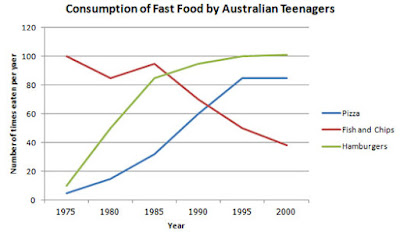
By: Ridwan Sa'at As we know there are two writing tasks in the Writing Section of IELTS exam; namely IELTS Writing Task 1 about charts or statistic data and Writing Task 2 on composing an essay.  Writing Task 1 aims for a report response on the given visual/chart/statistic data. Due to its task characteristics of which the participant of the test is asked to write a report, an opinion on the response is not necessary or is not allowed. What the participant needs to write is just a report on what can be observed from the visual.  From time to time the visuals of charts have been developed. There is a task of line charts, bar charts, pie charts, diagram, process and some more.